Bernarda’s household silence and obedience rule
The House of Bernarda AlbaBernarda’s household silence and obedience rule is the domestic code through which Bernarda Alba asserts control over speech, grief, work, and conduct. Its repeated commands turn the household into a space of enforced quiet and obedience, while the conclusion reveals the rule’s connection to family reputation: Bernarda orders silence even as she directs the household to present Adela’s death as that of a virgin.
Commands and Household Discipline
The rule is established at the opening of the play, when Bernarda enters the house after Antonio María Benavides’s funeral and commands the Servant to be quiet. She also rebukes the Servant for the state of the house and orders her away from the mourners. The exchange sets a pattern in which Bernarda answers visible grief not with consolation but with demands for silence, cleanliness, and work.
Her authority extends to her daughters’ mourning. When Magdalena cries, Bernarda tells her to stop and, if she must cry, to do so under her bed. Later, as the women leave, Bernarda bangs her stick to interrupt them and sends them away with a warning not to return for years. The rule is therefore enforced through both speech and gesture: an order can be reinforced by the sound of the stick and by Bernarda’s control over who may remain in the house.
Obedience, Gender, and Reputation
Bernarda makes obedience explicit as a general principle of the household, declaring that what happens there is what she commands. She couples this assertion with the prescribed division of gender roles: women are assigned needle and thread, while men are associated with the whip and mule. The rule’s authority thus rests not only on her position as head of the family but also on a social order that confines women to domestic life and expects them to submit.
Silence also protects the family’s standing in the village. Bernarda fears that neighbours will hear her daughters arguing, and the play’s commentary connects her concern for reputation to her anxiety about sexual scandal. Her final insistence that Adela died a virgin makes that connection decisive: household silence is not simply quiet imposed for its own sake, but a means of restricting what can be said about the family and concealing a truth Bernarda regards as damaging to its name.
Pressure and Contradiction
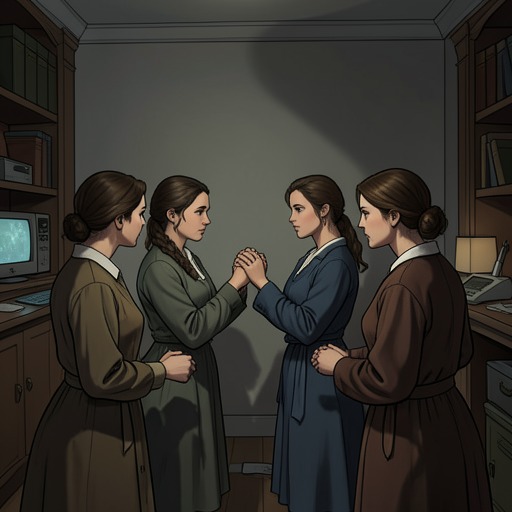
The rule operates in a household already marked by confinement and strain. The stage directions describe a thick-walled interior and a great, shadowed silence; later, the women listen as the harvesters’ music sounds beyond the house, and a blow against the walls comes from the stallion locked in the stable. These sounds bring the world outside and the pressure within into the same theatrical space, while Bernarda’s commands attempt to keep both speech and disorder under control.
That control does not remove conflict. When Poncia reports that the villagers are pursuing Librada’s unmarried daughter after the woman killed her child, Bernarda supports the crowd’s demand to kill her, while Adela protests. The episode exposes the violence tolerated by the village’s sexual-honour code and throws Bernarda’s insistence on order into sharp relief: the rule disciplines the women inside her household, but it does not amount to compassion or justice.
The Final Command
At the end, after Adela’s death, Bernarda refuses to go into the room and orders that the body be taken there and dressed as a virgin. She insists that no one is to say otherwise, repeats the claim that her daughter died a virgin, and tells the others not to weep. The rule culminates in a deliberate effort to regulate both mourning and public account: grief must be hidden, and the family’s preferred version of the death must be preserved.
The ending recalls Bernarda’s first command to the Servant, but the repetition now carries the knowledge of what her authority has failed to prevent. Her orders can still govern what the household says aloud; they cannot undo Adela’s death or erase the conflict that preceded it. Silence becomes both the final instrument of Bernarda’s control and the sign of the truth she is determined to suppress.